What Are Bonded Abrasives?
Bonded abrasives are among the most widely used tools in the metalworking, construction, and manufacturing industries. At their core, bonded abrasives consist of abrasive grains held together by a bonding agent — forming a solid, rigid tool capable of cutting, grinding, shaping, and finishing a wide variety of materials.
Unlike coated abrasives (such as sandpaper), where grains are attached to a flexible backing, bonded abrasives feature grains distributed throughout the entire body of the tool. This structure gives them exceptional durability, consistent performance, and the ability to handle high-pressure applications that demand precision and reliability.
As a leading Turkish abrasives manufacturer since 1983, ATEN has built decades of expertise in engineering bonded abrasive products that meet the rigorous demands of modern industry.
Key Components of Bonded Abrasives
Understanding what goes into a bonded abrasive product is essential for selecting the right tool for your application. Every bonded abrasive consists of three primary components:
- Abrasive Grains: The cutting element of the tool. Common grain types include aluminum oxide, silicon carbide, zirconia alumina, and ceramic alumina. Each grain type offers distinct advantages depending on the material being processed and the desired finish.
- Bonding Agent: The material that holds the abrasive grains together. The most common bond types are resinoid (resin), vitrified (ceramic), and rubber bonds. The bond type directly affects the wheel's hardness, speed rating, and suitability for specific tasks.
- Porosity: The open spaces between grains and bond material. Porosity plays a critical role in chip clearance, heat dissipation, and the overall aggressiveness of the abrasive tool.
The careful balance of these three elements determines the performance characteristics of the finished product — and this is where ATEN's formulation expertise truly shines.
Common Types of Bonded Abrasive Products
Bonded abrasives come in a wide range of shapes and sizes, each designed for specific industrial applications:
Cutting Wheels
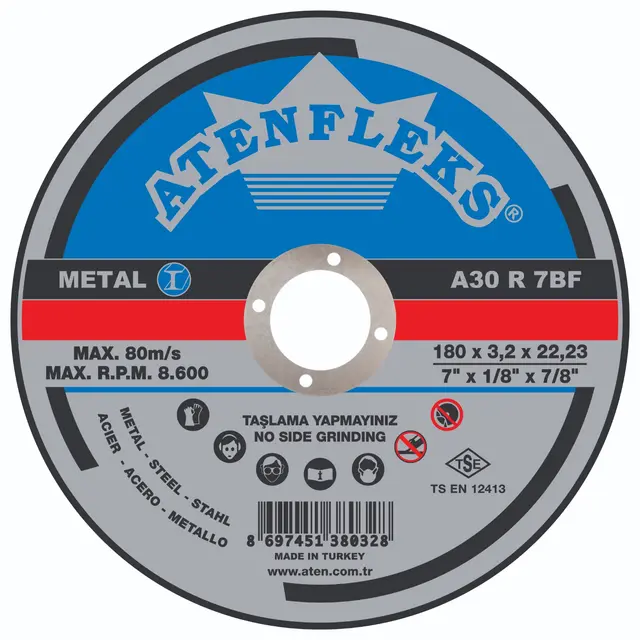
Designed for fast, clean cuts through metal, stainless steel, stone, and other hard materials. ATEN's cutting wheels are engineered for maximum efficiency with minimal material waste and reduced heat generation.
Grinding Wheels
Used for stock removal, surface preparation, and weld blending. ATEN manufactures grinding wheels in various diameters, thicknesses, and grain compositions to suit applications from heavy fabrication to precision finishing.
Depressed Center Wheels
A versatile subcategory that allows operators to grind flat surfaces and reach into corners. These wheels are staples in metal fabrication shops worldwide.
Specialty Shapes
Bonded abrasives can also be produced as mounted points, segments, and custom profiles for specialized machining and finishing operations.
How Bonding Types Affect Performance
Choosing the right bond type is just as important as selecting the correct abrasive grain. Here's a breakdown of the most common bonding systems:
- Resinoid Bonds: Made from synthetic resins, these bonds offer excellent flexibility and shock resistance. They are ideal for high-speed cutting and grinding applications and are the most common bond type in cutting and grinding wheels. ATEN's resinoid bonded products are engineered for superior structural integrity and consistent performance.
- Vitrified Bonds: Created from ceramic materials fired at high temperatures, vitrified bonds are extremely rigid and porous. They excel in precision grinding applications where tight tolerances and cool cutting are essential.
- Rubber Bonds: These provide a very smooth finish and are often used in polishing and regulating wheel applications.
Why ATEN Stands Out in Bonded Abrasives
With over four decades of manufacturing experience in Istanbul, ATEN has established itself as a trusted name in bonded abrasive technology. Several factors set ATEN apart from competitors:
Decades of Formulation Expertise
ATEN's in-house research and development team continuously refines grain, bond, and porosity combinations to deliver products that outperform industry standards. Every formulation is rigorously tested to ensure optimal cutting speed, longevity, and safety.
Custom Formulations for Unique Requirements
Not every application fits a standard product. ATEN offers custom bonded abrasive formulations tailored to specific customer requirements. Whether you need a unique grain blend for a challenging alloy, a specialized bond system for extreme operating conditions, or a non-standard wheel dimension, ATEN's engineering team works closely with clients to develop bespoke solutions that deliver measurable results.
Consistent Quality and International Standards
ATEN products are manufactured under strict quality control protocols and comply with international safety standards including EN 12413 and the oSa certification mark. This commitment to quality ensures that every wheel leaving the ATEN facility performs reliably and safely.
Vertically Integrated Production
From raw material selection to final testing, ATEN controls every stage of the manufacturing process. This vertical integration enables faster turnaround times, tighter quality control, and the flexibility to accommodate custom orders without compromising on standards.
Choosing the Right Bonded Abrasive for Your Application
Selecting the optimal bonded abrasive requires considering several factors:
- Material to be processed: Harder materials generally require softer-grade wheels, while softer materials work best with harder-grade wheels.
- Operation type: Cutting, rough grinding, precision grinding, and finishing each demand different product specifications.
- Machine type and speed: Always match the wheel's maximum RPM rating to your equipment's operating speed.
- Desired surface finish: Finer grains produce smoother finishes, while coarser grains remove material faster.
- Production volume: High-volume operations benefit from wheels engineered for extended life and consistent performance.
If you're unsure which product is right for your needs, ATEN's technical team is available to provide expert guidance and recommend the ideal solution — including custom formulations when standard products don't meet your requirements.
Safety Considerations
Bonded abrasives operate at high speeds and demand strict adherence to safety protocols:
- Always inspect wheels for cracks or damage before mounting
- Never exceed the maximum RPM indicated on the product
- Use appropriate personal protective equipment (PPE) including eye protection, gloves, and hearing protection
- Ensure proper wheel guards are in place on all equipment
- Store wheels in dry, temperature-controlled environments to preserve bond integrity
ATEN includes clear safety information and operating guidelines with every product to help operators work safely and efficiently.
Partner with ATEN for Your Bonded Abrasive Needs
Whether you're a large-scale manufacturer, a metal fabrication shop, or a distributor looking for a reliable supply partner, ATEN delivers bonded abrasive products that combine proven performance with innovative engineering. With the ability to produce custom formulations alongside a comprehensive standard product range, ATEN is uniquely positioned to meet the diverse needs of the global abrasives market.
Contact ATEN today to discuss your requirements and discover how our bonded abrasive solutions can improve your productivity, reduce costs, and deliver superior results.